After Halloween, the Dead Rise
In 2017, Pixar dropped seemingly the absolute most significant vivified film in Latinx-American mainstream society with the arrival of Coco. The fundamentally commended film dove into the folklore encompassing the Mexican occasion, Dia de los Muertos. For some Mexicans, Chicanos, and other Latin Americans, the film was Disney's hotly anticipated love letter to the way of life. Furthermore, for different Americans, it was a portal into a vacation that, in the US, is frequently entwined with Halloween.
The film likewise additionally encouraged a developing interest with certain parts of Mexican culture - from Oaxaca rising as one of the most sultry culinary pearls of the Americas and a Netflix arrangement devoted totally to tacos, to the surge of Dia de los Muertos merchandise showing up on the racks at Target for Halloween, people know there's something energizing about the occasion, yet they don't exactly have the foggiest idea what it is, or how to take advantage of it. That is the reason you see ladies take on the appearance of provocative calaveras, which is complete social assignment, or scenes of phony Dia de los Muertos marches in films.
Mexicans have a one of a kind method for tending to death, and it's best verbalized during Dia de los Muertos, Day of the Dead, which runs November 1 and 2. Rather than review demise as a forlorn end to life, Mexicans utilize this occasion to hold onto it as a feature of the whole life cycle. The calaveras and skeletons you see around the celebrations are articulations of the agreeable and inviting demeanor Mexicans have with their long lost. Beautiful special raised areas made with of the considerable number of things that their family members delighted in when they were alive are worked at home or by the tombstones in graveyards to respect perished friends and family.
Each fall, a huge number of Mexicans and Chicanos purchase skillet de muerto to put as contributions on these raised areas to bolster their progenitors. This current, it's a treat that rises above existence in the wake of death.
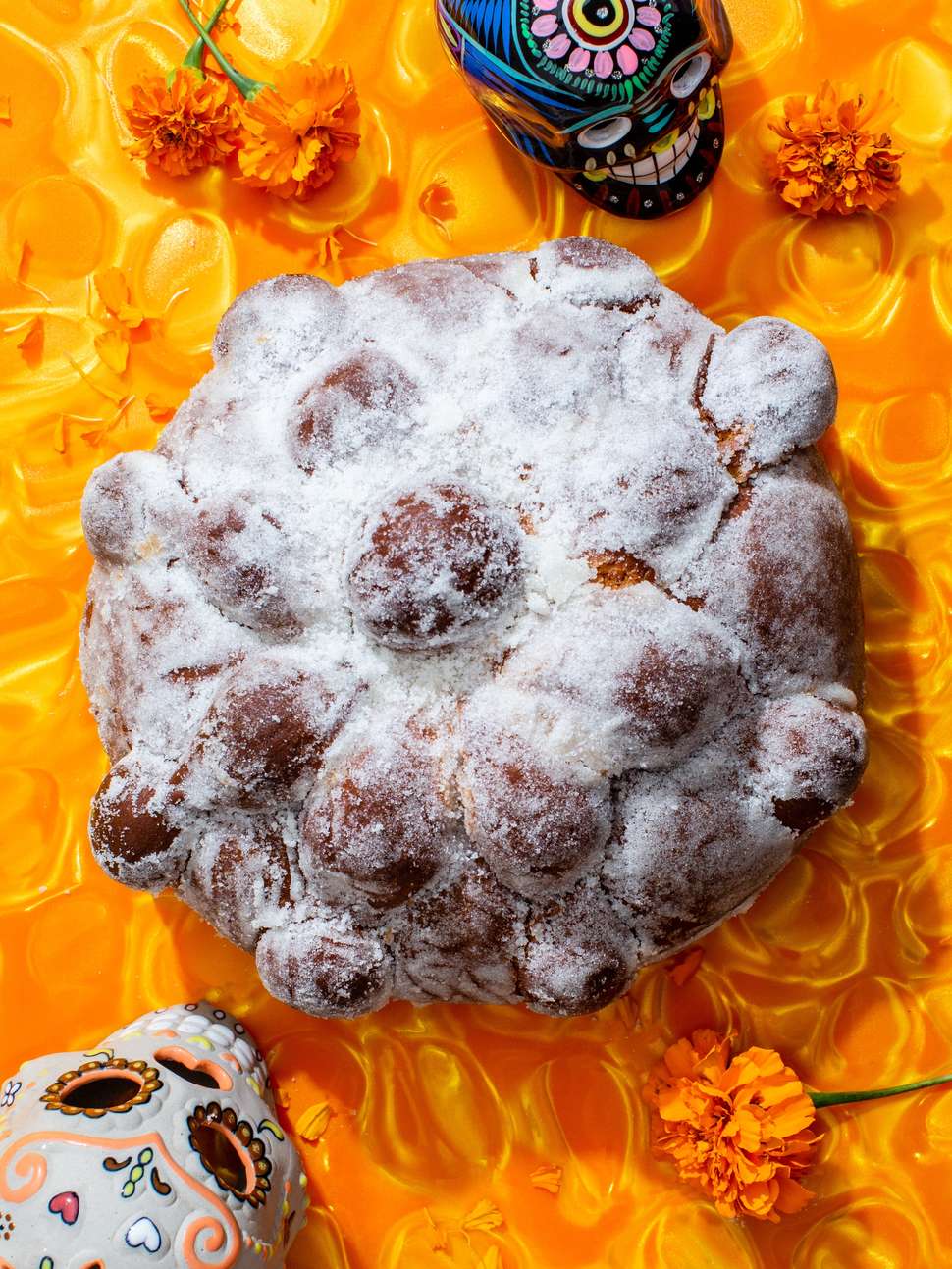
Container de muerto generally interprets in English as bread of the dead. It's a sweet, yeasted, round bread commonly seasoned with orange concentrate (as well as juice, pizzazz), anise seeds, and cinnamon and cleaned with granulated sugar or sesame seeds. Its springy surface makes it ideal for absorbing Mexican hot cocoa.
The state of the mixture is wealthy in the imagery around the occasion itself. To a few, the bread's round shape looks like a skull, while others state it speaks to the cycle of life. A couple of long segments of batter are set in a cross at the focal point of the bread, delineating the bones of the dead and tears of the living.
Since Coco's introduction, Mexican pastry shops, or panaderias, as Fany Gerson's La Newyorkina have seen a flood of interest for the occasion's quintessential nourishment. "I think, truly, since the motion picture turned out, we got a noteworthy increment in mindfulness outside of the Mexican people group," she says. "The enthusiasm for our rich social conventions from generally perceived brands can just serve to move love of dish de muerto and Dia de los Muertos to a significantly more extensive crowd, as the Day of the Dead occasion reverberates so profoundly over all socioeconomics," state Los Angeles' La Monarcha proprietors Ricardo Cervantes and Alfredo Livas.
Truth be told, the impact of the film is so firmly associated with this Dia de Muertos convention that La Monarca is collaborating with Disney Concerts and Pixar for the Coco Live-To-Film Concert Experience (including Eva Longoria and Benjamin Bratt). The pastry kitchen's skillet de muerto will be shown on a huge ofrenda, or special raised area for predecessors, at the concourse of the notorious amphitheater through the show's run.
Note: Pan de muerto, as most Mexican dish dulce, will in general dry out and go stale rapidly, so it's best eaten inside a day. On the off chance that you do have remains a day or so later, keep the skillet firmly wrapped at room temperature and warm it in the stove in foil. Prepared rounds can likewise be enveloped by plastic and put away in the cooler.
La Newyorkina
New York City
La Newyorkina's Gerson, additionally a prominent cookbook writer, says Dia de los Muertos is her preferred season. Truth be told, she arranged her wedding around the occasion. Gerson grew up eating skillet de muerto as a child in Mexico City and began making it herself as a grown-up when she moved to the US. She heats a conventional style container, one stacked with lumps of Mexican chocolate, and frozen yogurt sandwiches made with the bread. Starting at 2019, Gerson dispatches across the country so fans far and wide can make the most of her vacation treat.
Bedoy's Bakery
San Antonio
This bread shop has been a staple in San Antonio for about 60 years. Author Manuel Bedoy began preparing dish de muerto in line with cleric and network dissident Rev. Virgil Elizondo. The shop's container de muerto comes in numerous structures, from customary to brilliant breads molded like dolls. Bedoy's container de muerto figures conspicuously in the city's yearly Dia de los Muertos festivity.
La Calavera Bakery
This famous Georgia panaderia is known for utilizing natural fixings and regular produce in its heated merchandise, just as offering veggie lover varieties. La Calavera additionally sells skillet de muerto in little, singular sizes and enormous, shareable rolls. They utilize squeezed orange and grapefruit juice for enhancing.
Sheila's Bakery
This Michigan panaderia is a most loved in Detroit and Pontiac's prevalently Mexican people group all year for its variety of conchas, pasteles de tres leches, and chocolate flan. During the Dia de los Muertos season, the shops feel the groups as one of the locale's go-to spots for skillet de muerto just as conchas enhanced as pumpkins. The breads are accessible covered in granulated sugar, pink sprinkles, or cleaned with sesame seeds.
Dish Artesanal
Sisters Lizette and Marisol Espinoza propelled their panaderia business from home in 2016 utilizing a business kitchen worked by their dad and uncle. They proceeded to open their block and cement in the city's Logan Square neighborhood in 2018. Utilizing Marisol's instruction in French baked good making, the bread shop offers both Mexican and European-style prepared products. Their container de muerto mirrors that crossing point, with assortments including the customary, loaded down with nutella or cheddar, and a triple chocolate adaptation with cocoa sourced from Urupan, Michoacan.
La Mascota Bakery
This panaderia and eatery has been bolstering Angelenos in the barrio of Boyle Heights for about 70 years. It is renowned for its newly made tamales, early morning hours, and end of the week menudo. With respect to their container de muerto, hope to locate the exemplary formula, glossed over skulls, headless "kids," and pastel-shaded dish de muerto biscuits.
La Monarca
Twelve areas in the Los Angeles territory
La Monarca authors Ricardo Cervantes and Alfredo Livas longed for the flavor of their old neighborhood panaderias in the city of Monterey after they moved to the US, so they opened their first area in 2006 in Huntington Park, a dominatingly Latinx people group in southeast Los Angeles County. The pastry kitchen utilizes every single characteristic fixing like agave nectar and stays away from handled blends and additives. For the dish de muerto, La Monarca sticks with convention, utilizing new orange pizzazz. At that point they dunk their bread in spread and residue them in granulated sugar.


Comments
Post a Comment