Cocktails Are Getting Juicy-Juicy in Years To Come
From the outset, there was natural product.
When seasoned vodkas grew in the late 80s and 90s, tall colored pencil tinted organic product flavors overwhelmed on backbars and alcohol store racks, prepared to scent vodka-soft drinks and the infrequent Cosmopolitan, that famous pink blend of cranberry, lime, and Absolut Citron (in spite of the expression "enhanced," they once in a while offered much as far as real taste) with all its imitation "Blueberi" or "Ohranj" greatness.
Streak forward 30 or more years: expect organic product conditioned spirits to come back furiously, state pattern watchers like Nielsen CGA, which tracks drinking propensities at bars and cafés, and Flavorman, which creates refreshment enhances in its Willy Wonka-like Louisville research center. Catalyzed by the runaway accomplishment of White Claw and other spiked seltzers - which appear to be offered only in recognizable fruity assortments like dark cherry and lime - and following the unyielding drumbeat for "common" drinks in quest for the wellbeing pattern, liquor makers are returning to nuts and bolts: natural product.
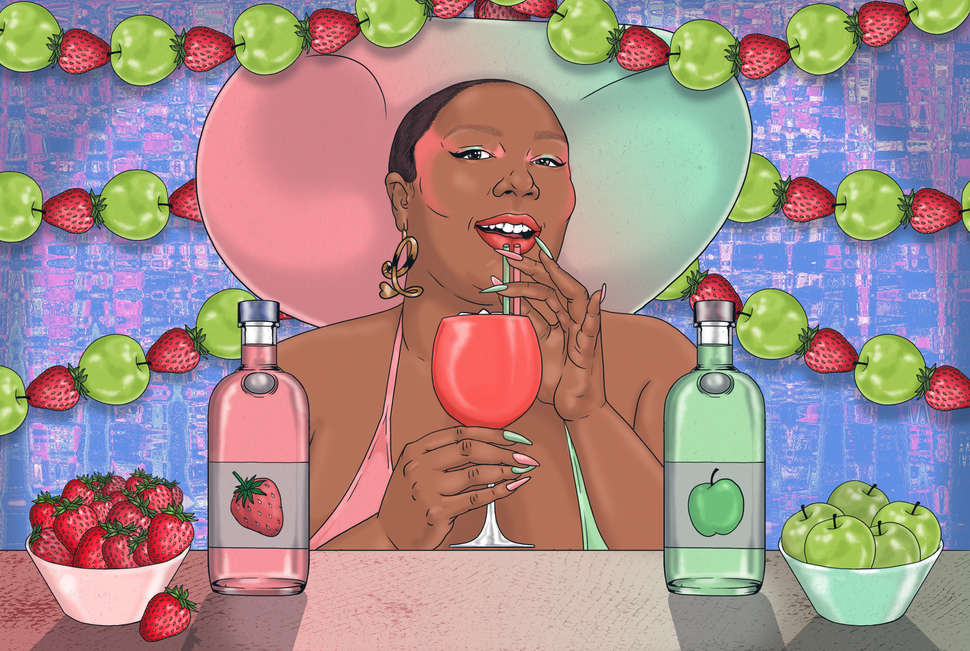
Obviously, things are a little extraordinary this time. Individuals might be wearing scrunchies once more, yet it's not the 90s any longer. Think Absolut Juice, which incorporates a strawberry season made with 5% squeeze and is getting repped by Lizzo, as a key case of the enhanced liquor wave to come. Berries are at the highest point of Flavorman's 2019 pattern list: "Since they can give a liberal profile (think shortcakes) just as wellbeing benefits (like blueberry combined with different cell reinforcements), berry flavors are regular identifiers in an assortment of refreshment sections," the flavor engineer says.
How could we arrive? "Seasoned spirits" have existed essentially since people made sense of how to distil their abundance crops into liquor, and nations with solid vodka societies, quite Russia and Poland, have long chronicles of making mixed vodkas.
Contrasted with customary imbuement strategies, which include soaking fixings in distillate for long timeframes, monetarily prepared vodkas have customarily depended on synthetic mixes: think crisp apple cuts versus fake "apple enhance." Those creations might be rack stable, however seldom do they approach the genuine article.
Swedish vodka maker Absolut makes a case for presenting the first economically accessible seasoned vodka, Absolut Peppar, in 1986. Why pepper? As indicated by the maker, "it appeared to be a smart thought to make things simpler for the many Bloody Mary bars springing up in Boston, New York, and somewhere else at the time."
Essentially, WE ARE GETTING FED-UP WITH THE BS, AND DEMANDING BETTER.
However, it was their Absolut Citron offering, which followed in 1988, that ended up being the distinct advantage. In particular, when then-Odeon barkeep Toby Cecchini made his adaptation of the Cosmo, it was in view of Absolut Citron solidly, he says in his apropos titled 2003 journal, Cosmopolitan. He picked the lemon-spiked vodka "for no specific explanation other than that it was the new, cool thing right now," and blended it with crisp lime juice, Cointreau orange alcohol, and "simply enough cranberry juice to give it a bashful pink become flushed."
During the '90s and '00s, seasoned vodkas started to get steam. From the outset, they adhered to the natural product family - cherry, berry, lemon, and tropical organic product - to satisfy the vodka-soft drink swarm, however then they got crazier and crazier, just as better and stickier, wandering into far-fetched tones like cupcake icing or cotton treats. Thinking back, Cinnabon-enhanced vodka, presented in 2013, was the minute that seasoned vodka went a little crazy, most experts concur. Ostensibly, the shark hopped directly over to bourbon, as Canada's cinnamon bourbon Fireball got steam in the US around a similar time, feeding an enhanced bourbon pattern.
"At the time, it was clear these treat flavors - whipped cream, sugary treats, or sweet flavors - were devised to get young ladies of drinking age [to expend these spirits] in clubs or bars," clarifies Kara Nielsen, a veteran nourishment and refreshment investigator, presently VP of patterns and advertising at CCD Innovation. "They were planned to give them something agreeable and fun that nearly felt like a change from teenagehood into adulthood." obviously this wasn't really required; a lot of young ladies were drinking bourbon perfect and didn't require a sweetened up rendition.
While it is deceitful to contend that spirits promoting is presently totally sex daze, purchasers are less tolerant about such outright strategies - and alcohol organizations appear to know not to attempt to offer toward this path at the present time.
"In a culture that is vigorously immersed with promoting trendy expressions, buyers are getting increasingly mindful of jumbling advertising strategies, for example, green-washing or rainbow-washing; the onus on brands is far higher to put their cash where their mouth is," says Danielle Yoon, a brand represetative for Absolut. "Essentially, we - recent college grads and Gen Z - are getting tired of the horse crap, and requesting better; which is an advancement I can remain behind."
Today, we've (generally) moved away from the fake, sweet like attributes that commanded a couple of years prior, and the pendulum has swung back to an accentuation on "characteristic" tones. Notwithstanding berry, Flavorman likewise is anticipating citrus flavors will overwhelm (counting as a "toner" to improve different flavors, for example, orange-mango or lemon-ginger), alongside watermelon and cucumber. So that Absolut Lime and Ketel One Grapefruit and Rose packaging is perfect.
SPIRITS ARE RIGHT BACK WHERE THEY STARTED: IN THE FRUIT BASKET.
Seasoned rums, likewise, are on the ascent, and appear to be taking a page from the vodka playbook: when all is said in done, these are white rums with some enhancing included, regularly impersonating the segments of well known tropical beverages like coconut, pineapple, banana, or lime. In principle, the wellbeing cognizant consumer can blend a lower-sugar form of a Piña Colada or a low-upkeep Mojito with these bottlings. Online purveyor Drizly likewise takes note of an uptick in berry-enhanced rums, extending from works of art like raspberry to appealing produce like "dragonberry," Bacardi's name for its blend of dragonfruit and strawberry. (Spiced rums, additionally a kind of enhanced rum, likewise proceed apace.)
Also, "seasoned gins," another class for US purchasers, are on the rising. It's as of now in full blossom in England; as indicated by IWSR Drinks Market Analysis, an information examination firm centered around the mixed refreshments advertise, in 2018 the classification had a 78% volume deals increment all inclusive. While all gin is enhanced with juniper, these are gins made with extra "regular flavorings," and may likewise incorporate sugar. In any case, enhanced gins are simply beginning to rise here in the US, with participants like Sipsmith's Lemon Drizzle or Glendalough's botanical, pink-tinged Rose Gin picking up space on alcohol store racks.
In the interim, the enhanced bourbon blast began by Fireball hasn't lessened. By and large, the technique has been to concentrate on flavors that as of now exist in bourbon - vanilla, caramel, maple, zest - and amp them up. Canada's Crown Royal has for quite some time been a pioneer in the space, turning out toothsome flavors like salted caramel and "Texas Mesquite." American makers also are turning out a lot of enhanced bourbon - think Knob Creek Smoked Maple, Wild Turkey's famous American Honey packaging, or Jim Beam's dark cherry-seasoned Red Stag.
Furthermore, among enhanced "moonshines" made with unaged bourbon, where the flavors normally conferred by barrel maturing aren't an issue, the blueprint is by all accounts diverting treat like flavors: improved apple, cherry, or peach pies, for instance.
Have insane flavors vanished out and out, washed away by an ocean of "regular" organic product flavors? In no way, shape or form. Stun esteem holds as a lot of intensity as ever - consider new participants, for example, Silver Spur Jalapeno Bacon Flavored Vodka (it's a corn-based vodka which oh dear, it doesn't suggest a flavor like hoe cake studded with chiles and smoky bacon, however for the most part is simply red hot), or delectable Skrewball Peanut Butter Whiskey, which has appropriately gathered up decorations at genuine spirits rivalries.
Indeed, the plausibility exists that the pendulum may swing back once more to bolder flavors, however not immediately. "While old style flavors are seeing a resurgence," Flavorman predicts, "Enhanced seltzers will proceed to develop and stretch out with fresher and trendier flavors." If spirits makers are planning to allure White Claw consumers, chances are they'll pursue a comparative flavor way. And keeping in mind that watermelon-or cucumber-seasoned White Claw appears the almost certain contender, it would be unquestionably all the more interesting to see an enhanced vodka-style Cinnabon-Claw collab. Up to that point, spirits are directly back where they began: in the natural product bushel.


Comments
Post a Comment